Fly from Here (2011) Yes has proved to be the most successful and long-lasting of the 1970s' progressive rock groups.
Created in 1968, the group has overcome drastic musical changes in the industry during the late `70's/`80's (punk/new wave), later the grunge/rap `revolution,' (or devolution), as well as changes in the band's line-up.
Unlike bands such as: Genesis and King Crimson who altered their sounds radically, alienating their original fans, Yes has retained a constant sound and though their style varies from album to album, the band performs the songs that loyal fans want to hear- many from the early `70's.
Jon Anderson, born in Oct. 25, 1944, in Accrington, Lancashire started out during the British beat boom as a member of the Warriors and later was in the band Gun, before going solo in 1967 with two mostly ignored singles. One day at the bar, he met bassist/vocalist Chris Squire (former member of the band the Syn), and having similar musical tastes, including an appreciation for the harmony singing of Paul Simon and Art Garfunkel- and they started to write songs together.
They recruited Tony Kaye- formerly of the Federals, on keyboards, Peter Banks (previously a member of the Syn), on guitar and Bill Bruford (drums), who had only just joined the blues band Savoy Brown a few weeks earlier. The name Yes was chosen for the band, a word short and direct.
Progressive rock, with a heavy dose of late-19th-century classical music, was also starting to make a noise that was being heard; through the recommendation of The Nice's manager, Tony Stratton-Smith (later the founder of Charisma Records), Yes filled in for Sly & the Family Stone at the Speakeasy Club in London. Cream selected Yes to open for their November 26, 1968 farewell concert at Royal Albert Hall. With gigs and radio play happening because of the exposure, Yes soon signed to Atlantic Records.
Their first album (self-titled- `Yes'), was released in November, 1969. The showed the group's high harmonies and folk and classical influences, fused into pop-music context. Yes supported the Nice at their Royal Albert Hall show, while they were preparing their second album,- `Time and a Word.'
Released in June of 1970, Peter Banks had left the group and was replaced by guitarist Steve Howe (ex- Syndicats/the In Crowd/Tomorrow). The record was far more sophisticated than its predecessor and included an overdubbed orchestra on some songs (Yes would not add an orchestra again until 30 years later). The group's fame in England continued to rise as they opened up for groups like- Iron Butterfly.
Yes' next album- the self-titled `Yes album,- became more complex as the group expanded their musicality to a higher level. "Your Move" became the group's first U.S. chart entry, at number 40), and "Starship Troopers" (taken from a Robert Heinlein novel) and "All Good People," gave the band ample opportunity to extend instrumental passages. The album reached # 7 in England and # 40 in America during the spring of 1971. Yes supported the album with their firsy US tour, opening up for Jethro Tull.
In august, 1971, Tony Kaye quit in August of 1971, to join Peter Banks' group Flash. He was replaced by the flamboyant and classically-trained keyboard player Rick Wakeman (Strawbs).
In December 1971, the band released- `Fragile,' the new album featured only four tracks by the group as a whole, "Roundabout," "The South Side of the Sky," "Heart of the Sunrise," and "Long Distance Runaround." The rest of the tracks showcased each member of the band individually. `Fragile,' again rose to # 7 in England and even higher in the US (to #4). "Roundabout," reached # 13 on the U.S. charts (and their most successful single for 12 years). The album's design started to pair artist Roger Dean's surreal landscape with their music.
`Close to the Edge,' was recorded in the late spring of 1972 and released in September. The album consisted of only three long tracks: "Siberian Khatru," the cosmic "And You and I" and epic masterpiece `Close to the Edge. The album reached # 4 four in England and # 3 in America without help from a hit.
Shortly after `Close to the Edge's release, Bruford had left to join King Crimson, and was replaced by drummer Alan White (John Lennon and Yoko Ono's Plastic Ono Band). As the band toured, Rick Wakeman had completed his first solo LP, `The Six Wives of Henry VIII,' and Rick played excerpts during his featured solo spot during tour.
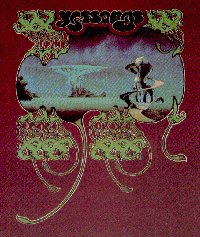
`Yessongs' was a 3-LP live album released in May of 1973, at over 120 minutes,all of it was uncut and reviews were good. The live album reached # 7 in England and # 12 in the United States.
`Tales from Topographic Oceans,- a double LP, was released in January of 1974 (earning a gold record from its advanced orders alone). Hardly light listening, (inspired by Jon Anderson's reaction to a set of Shastric scriptures), the dramatic album reached # 1 in England and # 6 on the American charts. After the tour, plans were announced for each member of the group to release a solo album of his own. Wakeman, privately unhappy with `Tales,' content, produced an epic second solo album, released in May of 1974 `Journey to the Center of the Earth,' was very successful and Rick left the band in June to pursue a solo career.
In August of 1974, Patrick Moraz (Refugee), took over Wakeman's position and three months later, `Relayer,' was released, reaching the top 5 in both the UK and US. Though not as flamboyant as Wakeman, Moraz proved solid replacement at keys. The band toured did not record together again for two and a half years.
Howe and Squire recorded solo albums- `Beginnings,' and `Fish Out of Water.' While White and Moraz added their own solo ventures, in July of 1976, Jon Anderson's `Olias of Sunhillow,' created a fantasy-based epic with a 12 page elaborated packaging of beautiful art. It reached # 8 and # 47 in America.
Wakeman replaced in late `76. The resulting album- `Going for the One,' (released in August of 1977), showed a more restraint and rock-oriented Yes with shorter songs. Te album was #1 for two weeks in the UK (# 8 in the US). Yes embarked on a massive tour shortly after the album's release, including their most successful American appearances ever.
`Tormato,' released a year later made the Top Ten in both England and America in the fall of 1978. Tafter a tour, the group members began working on solo projects, which saw the release of `The Steve Howe Album,' while Jon Anderson hooked up with keyboard player Vangelis in 1980 and released an album called- `Short Stories. Both albums reached the British Top Ten. Jon & Vangelis, went on to make several more records together.
After an unsuccessful attempt to start work on a new album, s Wakeman and then Anderson left the band in 1980. Squire (who owned the Yes name), brought in Trevor Horn (vocals, guitar) and Geoff Downes (keyboards), and the result- `Drama,' was released in August of 1980 and rose to the # 2 in the UK. And the top twenty in America. In January of 1981 Atlantic Records released `Yesshows,' a double live album which showed live performances from 1976 through 1978.
In April of 1981, the breakup of Yes was announced. Geoff Downes formed Asia with Steve Howe and the rest of the band pursued various projects. Later on, Chris Squire and Alan White announced the formation of a new group called Cinema, with Tony Kaye and guitarist Trevor Rabin, but proving unsatisfactory, Squire invited Jon Anderson to join. Yes was alive again.
In late 1983, the group released an unexpected #1 single "Owner of a Lonely Heart," which was quiter danceable. With this success, `90125,' was released and sold well.
In 1987 Yes released `The Big Generator,' which sold only moderately well. Critics were not kind. In 1986, Steve Howe reappeared as a member of the quintet GTR with ex-Genesis axe man Steve Hackett, the album hit # 11 in America. After an on-going legal dispute over who owned the group name- Yes; Anderson, Bruford, Wakeman and Howe released an album together which sold well, even getting MTV airplay. Their tour- "An Evening of Yes Music," sold out houses all over the country, including a 1990 gig at Madison Square Garden and a pay-per-view telecast (in which master bassist- Jeff Berlin (ex-Bill Bruford), filled in for an sick Tony Levin).
In the spring of 1991, a multi-year composite of Yes consisting of Anderson, Howe, Wakeman, Squire, Kaye, White, Rabin, and Bruford embarked on a blow-out world tour ( including the filming of a video historical documentary of the band, Yesyears: The Video) called Yesshows 1991. The album,- `Union,' which displayed a harsher sound reached # 7 in the UK and #15 in America. This mammoth three-hour shows which included album and solo material were well received
`Union's follow-up- `Talk,' was recorded by Anderson, Kaye, Squire, Rabin and White, and was not a success despite the solid tracks- "The Calling" and "I Am Waiting." Two live albums were issued in the mid-90s, and although well recorded, they failed to sell beyond the fans of Yes. Wakeman, with health issues, departed and was replaced by a young Russian keyboardist- Igor Khoroshev. 1997's disappointing `Open Your Eyes,' was released to little fanfare. Their next album- `The Ladder, was critically acclaimed, showing a more daring Yes.
Yes has never been idle, whether group or solo material, the band has always tried to continue different ventures. Their next medium? Video games for soundtrack to the hit PC strategy game- Homeworld.
"We've always been interested in the modern, the avant-garde," says Jon Anderson. "We were the first band to use lasers onstage."
The video game theme, "Homeworld (The Ladder)," was the title track on Yes' `The Ladder.'
`House Of Yes: Live From The House Of Blues,' was released as a live CD and DVD concert showcasing the band's `The Ladder,' tour.
The following year, the band went back thirty years ago to go outside the group, to produce'YesSymphonic' recorded with the San Diego Symphony Orchestra. Rick Wakeman said he was asked to play on the YesSymphonic tour. He refused, as he didn't want to play on orchestral arrangements that he wasn't involved with, and that he preferred the orchestra to be much bigger. A tour with a 50-piece symphony is garnishing excellent reviews and a DVD of the tour will be forthcoming. The band wrapped up their North American tour at Radio City Music Hall on September 8, three days before the tragic events in NYC of September 11. `Magnification,' the latest album was released in October 2001 and has gotten good reviews by the Prog comminity. The album has no formal keyboardist (though White does play piano) and
In 2002, Wakeman returned for the band's 35th anniversary tour. The band ceased to tour in 2004, partly due to health concerns regarding Anderson and Wakeman. Following a hiatus, Yes re-started in 2008 with keyboardist Oliver Wakeman and singer Benoît David. After of the release of Fly from Here (2011), which saw Downes returning on keyboards, the band recruited Jon Davison, lead singer of progressive rock band Glass Hammer, to replace David. Yes continues to perform to this day, more than 40 years since their formation.
Magnification and further touring (2001–04)
In 2001, Yes released their nineteenth studio album Magnification. Recorded without a keyboardist, the album features a 60-piece orchestra conducted by Larry Groupé; the first time the band used an orchestra since Time and a Word in 1970. The record was not a chart success; it peaked at number 71 in the UK and number 186 in the US.[30] Yes toured with a symphony orchestra in 2001 with keyboardist Tom Brislin as Wakeman was occupied with his solo tours. Their performance in Amsterdam was released on DVD in 2002 and CD in 2009 as Symphonic Live.
Following Wakeman's announcement of his return in April 2002, Yes embarked on their Full Circle Tour in 2002–2003 that included their first performances in Australia since 1973.The triple compilation album The Ultimate Yes: 35th Anniversary Collection was released in July 2003, reaching number 10 in the UK charts, their highest-charting album since 1991, and number 131 in the US. On 26 January 2004, the film Yesspeak premiered in a number of select theatres, followed by a closed-circuit live acoustic performance of the group that was released as Yes Acoustic: Guaranteed No Hiss later on. A 35th anniversary tour followed in 2004 which was documented on the live DVD Songs from Tsongas.
In 2004, Squire, Howe and White reunited for one night only with former members Trevor Horn, Trevor Rabin and Geoff Downes during a show celebrating Horn's career, performing three Yes songs. The show video was released in DVD in 2008 under the name Trevor Horn and Friends: Slaves to the Rhythm.
On 18 March 2003 minor planet (7707) Yes was named in honor of the band.[73]
Hiatus and departure of Jon Anderson (2004–10)
After the 35th anniversary tour in September 2004, Yes were inactive for four years. Anderson, unlike the other members, was not interested in producing a new studio album after the low sales of Magnification. He claimed that recording one was not "logical any more," and no announcement was made regarding a release of the new material.[74]
A 40th anniversary "Close to the Edge and Back" tour was scheduled to begin in 2008 – Anderson would later claim that the band had rehearsed four new "lengthy, multi-movement compositions" for the tour.[75] With Rick Wakeman unable to tour for health reasons, his son Oliver Wakeman was chosen to replace him on keyboards indefinitely. The tour was abruptly cancelled in May 2008 after Anderson suffered an asthma attack and was diagnosed with acute respiratory failure.
The remainder of Yes became tired of waiting for Anderson's return and in early September 2008, it was announced that he had been replaced by Canadian musician Benoît David, a member of Mystery and of the Yes tribute band Close to the Edge. From 2008 to 2010, Yes performed the In the Present Tour, with Asia and Peter Frampton supporting the band on certain legs. A number of dates in 2009 were cancelled when Squire required emergency leg surgery plus recovery time.
Fly from Here, Heaven & Earth, and related touring (2010–15)
In August 2010, it was announced that new material had been written for Fly from Here, Yes' twentieth studio album. Howe dispelled rumours that Anderson was invited back to sing on the record, asserting that all studio recording was to be carried out by "the line-up that actually...does the work."[80]
Yes then signed a deal with Frontiers Records and began recording in Los Angeles with Trevor Horn serving as producer. Much of the album material was extrapolated from a pair of songs written by Horn and Geoff Downes around the time that they had been Yes members during 1980 and the Drama album. During the recording sessions, the band thought it would be wise to bring Downes back to replace Oliver Wakeman on keyboards, reasoning that he was closer to the material. Upon completion of recording in March 2011, and post-production a month later, the album was released worldwide that July Fly from Here peaked at number 30 in the UK and 36 in the US.
In March 2011, Yes embarked on their Rite of Spring and Fly from Here tours to support Fly from Here, with Styx and Procol Harum supporting on select dates. 2011 saw the release of the live Yes album and DVD, In the Present – Live from Lyon, taken from the band's previous tour.
In February 2012, David was replaced by singer Jon Davison In February 2012, after David contracted a respiratory illness, he was replaced by Glass Hammer singer Jon Davison. Davison was recommended to Squire by their common friend Taylor Hawkins, drummer for the Foo Fighters. Davison would join Yes to complete the band's scheduled dates across the year.
In August 2013, the fan campaign Voices for Yes] was launched to get the band into the Rock and Roll Hall of Fame. The campaign was headed by two US political operators: John Brabender, senior media strategist for Republican Rick Santorum's 2012 US presidential campaign, and Tad Devine, who worked on Democrats John Kerry's 2004 presidential campaign and Al Gore's 2000 campaign.[89][90][91] Also involved were former NBC president Steve Capus and former Director of the White House Office of Political Affairs Sara Taylor.[92] On 16 October 2013, Yes failed to be inducted. In November 2013, Anderson expressed a wish to return to Yes in the future for a "tour everybody dreams of", and cited Yes's nomination for inclusion into the Rock and Roll Hall of Fame as a motive for a possible reunion.[95] Howe, however, has stated his opinion of Anderson returning, asserting "I'm not sure our mutual desire to achieve the same thing exists any more ... I think there has to be some element of moving on."
From March 2013 to June 2014, Yes completed their Three Album Tour where they performed The Yes Album, Close to the Edge and Going for the One in their entirety. During the tour, they led a progressive-rock themed cruise titled "Cruise to the Edge".[99] A second cruise happened April 2014, and the band headlined the November 2015 edition. The show on 11 May 2014 in Bristol was released as Like It Is: Yes at the Bristol Hippodrome in 2014, featuring performances of Going for the One and The Yes Album.
Heaven & Earth, the band's twenty-first studio album and first with Davison, was recorded between January–March 2014, at Neptune Studios in Los Angeles with Roy Thomas Baker as producer and former band member Billy Sherwood as engineer on backing vocals[103] and mixer. Squire described the recording process as "a very enjoyable experience" and Baker someone "really good to work with", and described the writing process of the album which involved Davison travelling to Howe and Squire's homes to write and develop the new music, both "musically and lyrically".
To promote Heaven & Earth, Yes resumed touring between July–November 2014 with a world tour covering North America, Europe, Australia, New Zealand and Japan, playing Fragile and Close to the Edge in their entirety with select songs from Heaven & Earth and encores. The show in Mesa, Arizona was released in 2015 as Like It Is: Yes at the Mesa Arts Center which features the performances of Close to the Edge and Fragile.
Squire's death, Sherwood rejoins, and touring (2015–present)
In May 2015, news of Squire's diagnosis with acute erythroid leukemia was made public. This resulted in former guitarist Billy Sherwood coming in to replace him during Squire's treatment for their 2015 summer North American tour with Toto between August–September, and their third annual Cruise to the Edge voyage in November. However, Squire's condition deteriorated soon after; he died on 27 June at his home in Phoenix, Arizona. Downes first announced his passing on Twitter. Squire asked White and Sherwood to continue the legacy of the band,[109] which Sherwood recalled "was paramount in his mind ... so I'm happy to be doing that."Yes performed their first show without Squire, the first in their 47-year history, on 7 August 2015 in Mashantucket, Connecticut.
In October 2015, Yes were nominated for induction into the Rock and Roll Hall of Fame for a second time but again failed to be inducted. A month later, they completed their annual Cruise to the Edge voyage.
In January 2016, news of the formation of Anderson, Rabin and Wakeman, a band formed by the three named Yes members, was announced. They revealed they had started to develop material for an album.The band will tour North America and Europe from October 2016 to March 2017 as An Evening of Yes Music and More, playing Yes songs and music from their upcoming album.
In 2016, Yes performed Fragile and Drama in their entirety on their April–June European tour. Trevor Horn sang "Tempus Fugit" with the band for two UK shows.This was followed by Drama and sides one and four of Tales from Topographic Oceans performed across North America between July–September. White missed the latter tour after he underwent back surgery and needed time to recover which led to American drummer Jay Schellen taking his place.White returned to the group in time for the band's Japanese tour scheduled for November 2016.
In 2016, Yes were nominated for induction into the Rock and Roll Hall of Fame for the third time.
Yes toured the US and Canada with the Yestival Tour from August to September 2017, performing at least one song from each album from Yes to Drama. Howe's son Dylan joined the band as a second drummer, the first time since the Union Tour that Yes had two drummers playing simultaneously. The last seven shows were cancelled following the unexpected death of Howe's son and Dylan's brother Virgil.
In February 2018, Yes headlined Cruise to the Edge which involved Kaye as a special guest performer, marking his first performance with the band since 1994. This was followed by the start of their 50th Anniversary Tour in March with a European leg, playing half of Tales from Topographic Oceans and a selection of songs from their history. The two London dates included an anniversary fan convention which coincided with the release of Fly from Here – Return Trip, a new version of the album with lead vocals and mixes by Horn, who also performed as a special guest singer during the leg. A US leg will take place in June and July that will include guest performances with Kaye and Patrick Moraz, who last performed with Yes in 1976. Schellen continues to play as a second drummer to support White, who has had a bacterial infection in his joints since November. An anniversary compilation album is scheduled for release in August 2018.
Yes updates courtesy of Yes Wiki Page
Current members
Steve Howe – guitars, lap steel & pedal steel guitars, laúd, mandolin, backing vocals (1970–1981, 1990–1992, 1995–present)
Alan White – drums, percussion, backing vocals (1972–1981, 1983–present)
Geoff Downes – keyboards (1980–1981, 2011–present)
Billy Sherwood – vocals (1994, 1997–2000, 2015–present), guitar, keyboards (1994, 1997–2000), bass guitar (2015–present) (also worked with the band as a producer or mixer in 1991, 1996–1997 and 2014–2015)
Jon Davison – lead vocals, acoustic guitar, percussion, keyboards (2012–present)
Anderson, Rabin, & Wakeman.
Anderson, Rabin and Wakeman was formed by three past members of the progressive rock band Yes who joined the band at different times in its history of different line-ups. Singer Jon Anderson co-founded the band in 1968, guitarist/singer Trevor Rabin joined in 1983, and keyboardist Rick Wakeman joined in 1971. The three only performed together for the 1991–92 Union Tour, but never all worked together on a studio project. Away from Yes, Anderson and Rabin, Anderson and Wakeman, and Wakeman and Rabin have worked together in various capacities.
The group was first announced in February 2010 when Wakeman spoke about a potential project with Rabin "and a couple of other ex-members of Yes who will remain nameless" on his Planet Rock radio show. This was later revealed to a plan to form a supergroup with Anderson, Rabin, Wakeman, and former Yes drummer Bill Bruford, but Bruford soon denied any involvement. Developments then progressed slowly, mainly due the three members' commitments to their solo projects and conflicting schedules. In October 2010, Rabin announced the group had yet to formally begin work on the project, but were "really itching" to proceed with it. Following the death of bassist and Yes co-founder Chris Squire in 2015, Wakeman said it was a right time for the three to record new songs and perform on stage. In January 2016, they officially announced the band and secured Brian Lane as their manager, who used to manage Yes in the 1970s and currently manages Wakeman.
Album and tour
Initial plans to record a studio album were revealed in June 2011 when Anderson said the three were working on new songs with the aim to perform them with songs from the Yes albums 90125 (1983), Big Generator (1987), and Talk (1994).Musical ideas were exchanged between the three on-line by sharing music files recorded at their own locations. Anderson described their new songs as "unique"] that will feature a group of side musicians. Wakeman said the songs sound "Amazing. Very fresh, full of life, energy and melody".[ One suggested plan is to release in three parts, as it would contain some pieces of extended length. In June 2016, Rabin indicated that recording was still in an early stage, consisting of "bits and pieces of song ideas", and that recording deals from several labels had been declined so the trio could maintain control over the album's musical direction. Rabin said that the trio had agreed to make the upcoming tour their priority, putting the album "on the back burner". In September 2016, Anderson said the trio would "probably record in January or February [2017]."
Their debut tour named An Evening of Yes Music and More Tour is due to cover the United States and Europe from October 2016 to March 2017. The three are due to tour with bassist Lee Pomeroy and drummer Lou Molino III. Anderson predicted a live set with "one or two songs" from Talk (1994), but there are no plans for new music to be performed.
Yes Discography
Studio albums
Yes (1969)
Time and a Word (1970)
The Yes Album (1971)
Fragile (1971)
Close to the Edge (1972)
Tales from Topographic Oceans (1973)
Relayer (1974)
Going for the One (1977)
Tormato (1978)
Drama (1980)
90125 (1983)
Big Generator (1987)
Union (1991)
Talk (1994)
Keys to Ascension (1996)
Keys to Ascension 2 (1997)
Open Your Eyes (1997)
The Ladder (1999)
Magnification (2001)
Fly from Here (2011)
Heaven & Earth (2014)
Live albums
Yessongs (1973) (recorded: 1972)
Yesshows (1980) (recorded: 1976–1978)
9012Live: The Solos (1985) (recorded: 1984)
Keys to Ascension (1996) (recorded: 1996)
Something's Coming: The BBC Recordings 1969–1970 (1997) (recorded: 1969–1970)
Keys to Ascension 2 (1997) (recorded: 1996)
House of Yes: Live from House of Blues (2000) (recorded: 31 October 1999)
Songs from Tsongas (2005) (recorded: 15 May 2004)
The Word Is Live (2005) (recorded: 1970–1988)
Symphonic Live (2005) (recorded: 22 November 2001)
Live at Montreux 2003 (2007) (recorded: 14 July 2003)
Union Live (2011) (recorded: 1991)
In the Present – Live from Lyon (2011) (recorded: 1 December 2009)
Like It Is: Yes at the Bristol Hippodrome (2014) – 2 CD (recorded: 11 May 2014)
Progeny: Seven Shows from Seventy-Two (2015) (recorded: 31 October – 20 November 1972)
Progeny: Highlights from Seventy-Two (2015) – 2 CD/3 LP Box Set (recorded: 31 October – 20 November 1972)
Like It Is: Yes at the Mesa Arts Center (2015) – 2 CD (recorded: 12 August 2014)
Topographic Drama – Live Across America (2017) – 2 CD/3 LP (recorded: February 2017)
Anderson Bruford Wakeman Howe albums
Studio albums
Anderson Bruford Wakeman Howe (1989)
Live albums
An Evening of Yes Music Plus (1993)
Live at the NEC – Oct 24th 1989 (2010)